Search
New Music Festival of Aix-en-Provence
27.06.2007
Practical Information:
Location: Grand Salon
Concert organized as part of a collaboration with the Festival d’Aix-en-Provence. For the past three years, the two institutions have been working together on a commission awarded to the composer-in-residence at the Académie de France in “Rome,” which was subsequently premiered at concerts in Rome and Aix-en-Provence.
The concert on June 27, 2007, will be performed by the Diotima Quartet, which will be in residence at the Villa Medici for the occasion. The world premiere of Franck Bedros’s “Sian,” a resident at the French Academy in Rome from 2006 to 2008 and a recent recipient of the SACEM Young Composers Award, will be performed on June 30, 2007, in Aix-en-Provence, as part of the festival’s opening weekend (June 29–July 22, 2007).
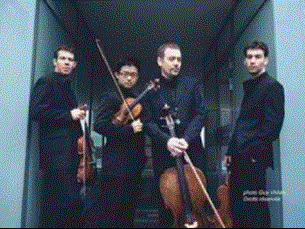
The program features Alban Berg’s String Quartet, Op. 3; Claude Debussy’s Études (“For the ‘Five Fingers’ after Mr. Czerny,” “For Fourths,” “For Contrasting Tones,” “For the Eight Fingers”), Franck Bedrossian with *Tracés d’ombres*, and Thomas Adès with his Quintet for Piano and Strings. The works will be performed by the Diotima Quartet, consisting of Naaman Sluchin (violin), Yun-Peng Zhao (violin), Franck Chevalier (viola), and Pierre Morlet (cello), accompanied on piano by Alain Planès.
About Franck Bedrossian’s *Tracés d’ombres* (2007): The Play’s Form proceeds through contrasts and transformations of textures, aiming to establish a dialectic through timbre. Oscillating slowly and irregularly between roughness and transparency, the soundscape evokes the wanderings of a human voice and its haunting fear of silence.
Founded by graduates of the Paris and Lyon National Conservatories of Music, the Diotima Quartet quickly made a name for itself by winning third prize at the Karl Klingler Competition in Berlin in 1998, first prize at the FNAPEC Competition in Paris in 1999, and the Contemporary Music Prize at the London International Competition in 2000. The quartet’s name pays homage to Luigi Nono’s work, *Fragmente-stille, an Diotima*, thus affirming its strong commitment to the 20th-century repertoire, ranging from Bartók and the Second Viennese School to Carter, Lachenmann, and Ferneyhough.
While committed to bridging the gap between contemporary composition and the classical and romantic traditions, the ensemble does not neglect the works of Beethoven, Schumann, Debussy, or Janáček. To hone their artistry, the quartet has benefited from the guidance of Jean Sulem, as well as advice from Walter Levin and the Alban Berg Quartet during masterclasses.
The Diotima Quartet has performed extensively in France, notably at the Louvre Auditorium, the Festival d’Automne, the Festival Présences, the Cité de la Musique, and IRCAM, as well as abroad in Berlin, Dortmund, Strasbourg, Brussels, Helsinki, Lisbon, and Aldeburgh. Following a residency at the June in Buffalo festival, followed by concerts in New York and Washington, D.C., the ensemble continues its worldwide tours in Japan, Budapest, Stockholm, Madrid, and Cologne. In 2007, it will be in residence at the Casa da Música in Porto.
In terms of their discography, their first CD, dedicated to Lachenmann and Nono and released by ASSAI, received the Académie Charles Cros’s “Coup de cœur” award, a “Diapason Découverte,” and a “Diapason d’Or” for 2004 in the Young Talents category. Their next recording will be dedicated to Janáček’s two string quartets.
From Indiana University to Pierre Boulez, Alain Planès’s career has been shaped by his interactions with the greatest figures in music, elevating him to the ranks of the most acclaimed pianists of his generation. After making his debut in Lyon, where he performed with an orchestra at the age of eight, he continued his studies at the Paris Conservatory under the mentorship of Jacques Février, before honing his skills in the United States, in Bloomington, with Menahem Pressler, Janos Starker, György Sebök, and William Primrose. A close collaborator of Janos Starker, he then became, at the suggestion of Pierre Boulez, the principal pianist of the Ensemble Intercontemporain until 1981.
His career as a soloist has taken him to the stages of the world’s greatest festivals—from Aix-en-Provence to La Roque d’Anthéron, including La Folle Journée in Nantes—and he has performed alongside prestigious ensembles such as the Orchestre de Paris and the Orchestre National de France. A close friend of Rudolf Serkin, he regularly participates in the prestigious Marlboro Festival. A sought-after chamber musician, he has collaborated with Maurice Bourgue, Shlomo Mintz, Michel Portal, and the Prazak and Talich quartets.
Alain Planès has also distinguished himself as a musical director of operas such as Janáček’s *Le Carnet d’un disparu*, staged by Claude Régy in 2001, and Philippe Manoury’s *La Frontière* in 2003. He has released a discography for Harmonia Mundi that has been acclaimed by international critics, including a complete set of Schubert’s Sonatas, as well as recordings dedicated to Debussy’s Preludes on period instruments, and works by Chopin, Haydn, Scarlatti, and Janáček.
Born in 1971 in London, Thomas Adès studied piano and composition at the Guildhall School of Music with Paul Berkowitz and Robert Saxton, before continuing his studies at King’s College, Cambridge, where he graduated in 1992. He first gained attention in 1993 during a recital at London’s Purcell Room with the premiere of *Still Sorrowing*, and his career took off rapidly with the performance of his *Chamber Symphony* in Cambridge in 1993 and *Living Toys* at the Barbican Centre in 1994.
International commissions then came one after another from the BBC and the Endellion Quartet, culminating in the success of his opera *Powder Her Face*, commissioned in 1995 by the Almeida Theatre. Starting in 1999, he took over as artistic director of the Aldeburgh Festival while also pursuing an extensive career as a conductor, leading ensembles such as the BBC Symphony Orchestra, the New York Philharmonic, and the London Sinfonietta. His works are now part of the repertoire of prestigious ensembles such as the Berlin Philharmonic under the direction of Sir Simon Rattle, and he was the guest of honor at the 17th edition of Radio France’s Festival Présences in 2007.